
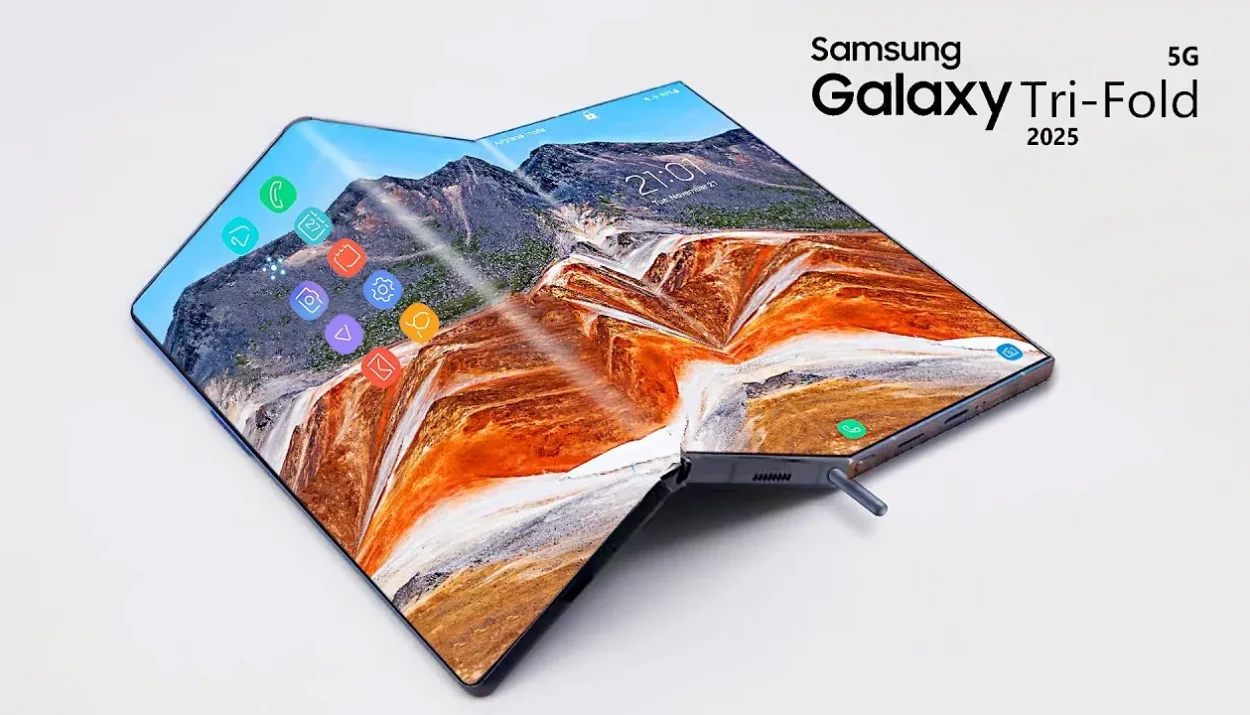
Samsung has taken another bold step in the foldable‑phone race with the debut of the Galaxy Z TriFold, a three‑panel smartphone designed to function as both a pocketable device and a full‑sized tablet. Announced on Tuesday, the TriFold expands into a 10‑inch QXGA+ display (2160 × 1584), offering 1600‑nit peak brightness and a 120Hz refresh rate.
A Three‑Panel Design With Tablet Ambitions
The TriFold’s two side panels fold inward to protect the main screen, and Samsung has added an auto‑alarm system to warn users if they’re folding it incorrectly. When fully opened, the device becomes remarkably thin—just 3.9 mm at its slimmest point. Folded, it measures 12.9 mm, still competitive given its complexity.
For comparison, the iPhone 17 Pro is 8.75 mm thick, while the ultra‑thin iPhone Air measures 5.64 mm.
The TriFold can run three portrait‑oriented apps at once, one per panel, or stretch a single app across all three screens. It also supports external monitors, positioning it as a productivity‑focused hybrid device.
Samsung is offering the phone in black with 16GB of RAM and either 512GB or 1TB of storage, though there’s no MicroSD slot. Power comes from a 5,600 mAh three‑cell battery, with one cell embedded in each display segment. A custom Snapdragon 8 Elite processor drives the device.
Camera System and Build Quality
On the back, the TriFold features:
200MP wide‑angle camera
12MP ultra‑wide lens
10MP telephoto with 3× optical and 30× digital zoom
Two 10MP front cameras—one on the cover screen and one on the main display—handle selfies and video calls.
Samsung calls the TriFold its most advanced foldable yet, thanks to a redesigned dual‑hinge mechanism, reinforced display materials, a titanium hinge housing, and an Advanced Armor Aluminum frame.
The device launches first in Korea on December 12, with a global rollout to follow. The expected price is $2,440.
Analysts: A Better Phone–Tablet Hybrid
Industry analysts say the tri‑fold format offers clear advantages over traditional bi‑fold designs.
Kristen Hanich of Parks Associates argues that the TriFold is a superior two‑in‑one device because it behaves more naturally as both a phone and a tablet. Mark N. Vena of SmartTech Research adds that it gives power users more room for multitasking, content creation, and productivity—essentially a 10‑inch tablet that fits in a pocket.
For users who rely on reading glasses, the larger display is a major benefit, says Rob Enderle of the Enderle Group. It also enhances video viewing and carries a certain status appeal due to its rarity.
But Demand Remains Uncertain
Despite the engineering achievement, some analysts question whether consumers actually want tri‑fold phones.
Tim Bajarin of Creative Strategies sees the TriFold primarily as a showcase of Samsung’s innovation rather than a response to market demand. Gartner analyst Tuong Huy Nguyen argues that foldables still lack a compelling app ecosystem that justifies their high price.
Until foldables either become cheaper or offer unique, high‑value experiences, he says, they will remain a niche product.
Could Apple Change the Game?
Several analysts note that Apple’s entry into the foldable market could dramatically shift consumer interest. Apple is known for waiting until a technology is mature before adopting it, but if it releases a folding iPhone, demand could surge.
Ross Rubin of Reticle Research points out that Apple also has an advantage with developers, who historically optimize apps for Apple hardware more readily than for Android tablets.
Samsung’s timing is notable, Rubin adds, as Google is exploring a merger of Android and ChromeOS elements to better support large screens.
A Glimpse of the Future of Mobile Computing
While some experts remain skeptical, others see tri‑folds as an important testing ground for next‑generation mobile devices. Vena argues that the real breakthrough will come when software and AI fully exploit the expanded screen space.
Analyst Anshel Sag believes foldables will eventually cannibalize more of the tablet market. For some users, foldables have already replaced tablets entirely.
Hanich agrees that tri‑folds could evolve into smartphone, tablet, and even laptop replacements as the category matures.