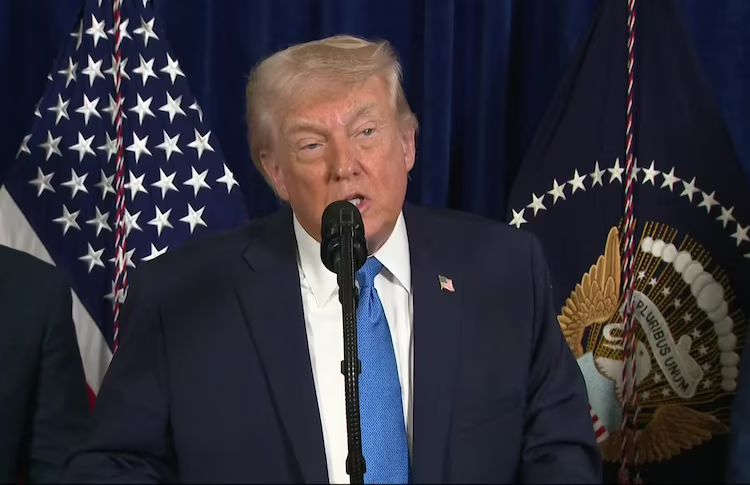
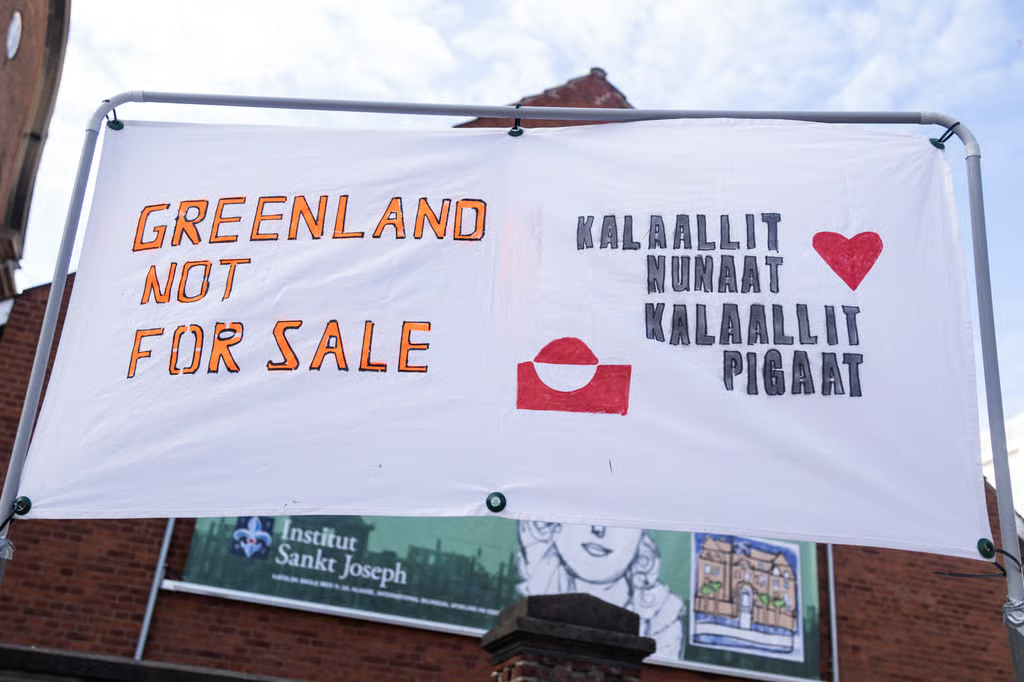
Greenland’s political leadership has delivered an unusually unified and unmistakably firm message to U.S. President Donald Trump: the island is not for sale, not up for negotiation, and not interested in becoming anyone’s territory.
In a rare joint statement, the leaders of all five parties represented in Greenland’s parliament declared:
“We do not want to be Americans, we do not want to be Danes, we want to be Greenlanders.”
Their response follows renewed U.S. interest in the Arctic territory — interest that has ranged from strategic military positioning to Trump’s widely publicized idea of purchasing Greenland. For Greenlandic politicians, the episode has become an opportunity to assert their identity, autonomy, and long‑term political ambitions.
🌍 A Nation-in-the-Making
Greenland is part of the Kingdom of Denmark but has extensive self‑rule, controlling its own government, natural resources, and domestic affairs. Many Greenlanders see full independence as a long‑term goal — but on their own terms, not as the result of geopolitical bargaining.
The joint statement reflects a shared political vision across the ideological spectrum:
Greenland’s future should be shaped by Greenlanders, not foreign powers.
External interest — whether from the U.S., Denmark, or others — must respect the island’s autonomy.
Identity and self‑determination are central to Greenland’s political project.
This unity is striking in a political landscape that is often divided on economic and social issues.
🧭 Why the U.S. Cares
Washington’s interest in Greenland is not new. The U.S. already operates the Thule Air Base in the island’s far north, a key asset for missile detection and Arctic operations. But climate change, melting sea ice, and new shipping routes have dramatically increased the Arctic’s strategic value.
For the U.S., Greenland represents:
a critical military vantage point
access to rare earth minerals
influence in a region where Russia and China are expanding their presence
Trump’s suggestion of buying the island — though dismissed by many as outlandish — was rooted in this broader strategic competition.
🧊 Why Greenland Pushed Back So Strongly
Greenlanders saw the idea of a purchase as dismissive of their identity and political agency. The joint statement was not just a rejection of Trump’s proposal; it was a declaration of national dignity.
Key motivations behind the strong response include:
Protecting sovereignty: Greenlanders want control over their land and resources.
Rejecting colonial echoes: The idea of being “bought” evokes a painful history of external rule.
Affirming identity: Greenlandic culture, language, and nationhood are central to political life.
Signaling unity: All parties standing together sends a message to both Washington and Copenhagen.
🇬🇱🇩🇰 A Message to Denmark, Too
While the statement was directed at the U.S., it also subtly addressed Denmark. Many Greenlanders feel that Copenhagen still exerts too much influence over foreign policy and economic decisions.
By asserting “we do not want to be Danes,” Greenland’s leaders emphasized that their national identity is distinct — and that independence remains a long‑term aspiration.
🔮 What Comes Next
The episode has elevated Greenland’s voice on the global stage. It has also highlighted the island’s growing confidence as it navigates between major powers.
Greenland’s leaders are signaling that:
they welcome international partnerships, but only on equal footing
they will not be treated as a commodity
their path toward greater autonomy — and possibly independence — is non‑negotiable
In a world increasingly focused on the Arctic, Greenland is making one thing clear: its future belongs to its own people.