
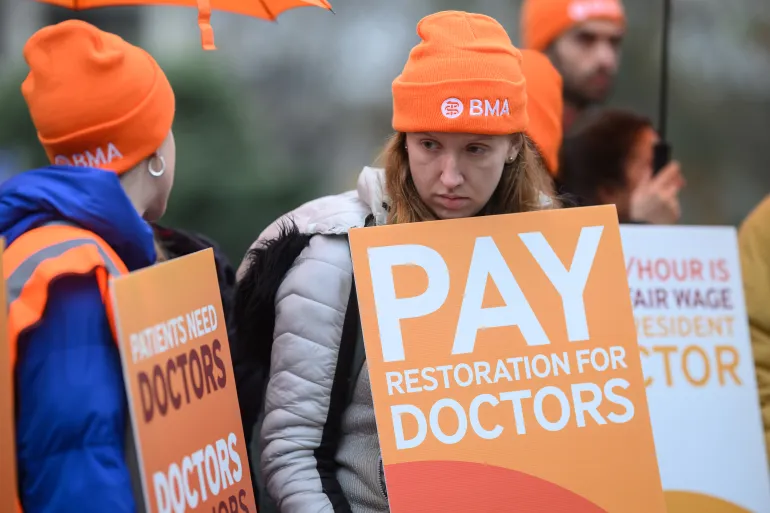
Resident doctors across England are preparing for a five‑day walkout this week after voting down the government’s latest proposal aimed at ending their long‑running dispute over pay and working conditions.
The strike — set to begin at 07:00 GMT on Wednesday and continue until 07:00 GMT next Monday — comes after members of the British Medical Association (BMA) overwhelmingly rejected the offer in an online ballot.
Doctors Say Offer Falls Short
Jack Fletcher, chair of the BMA’s resident doctors committee, said the vote reflected widespread frustration among frontline physicians.
“Tens of thousands of doctors have said ‘no’ to an offer that is clearly too little, too late,” he said, adding that the proposal failed to address concerns about both pay and working conditions. Fletcher stressed that the union remains open to further negotiations.
Resident doctors — previously known as junior doctors — make up nearly half of England’s medical workforce.
Government Urges Strike to Be Called Off
Health Secretary Wes Streeting criticized the planned walkout, calling it “self‑indulgent, irresponsible and dangerous.” He urged the BMA to reconsider, arguing that the strike poses risks to patients during a period of rising flu cases.
Speaking to Sky News, Streeting said the government would be willing to discuss rescheduling the strike to reduce pressure on hospitals.
Flu Cases Surge as Winter Pressures Mount
England is facing an unusually severe flu season. Hospital admissions linked to influenza jumped by more than 50 percent in early December, reaching an average of 2,660 patients per day — the highest level recorded at this point in the year. Health officials warn that the peak has not yet arrived.
Across Europe, health systems are reporting similar spikes, with many countries struggling to manage early and intense flu waves.
Union Members Reject Offer by Wide Margin
According to the BMA, 83 percent of resident doctors who participated in the vote rejected the government’s proposal. Turnout was 65 percent among the union’s more than 50,000 members.
The offer did not include any new pay terms. The BMA has been pushing for improved compensation since before the Labour Party won last year’s general election.
Shortly after taking office, Streeting agreed to a 22 percent pay increase — still below the 29 percent the union says is needed to restore salaries to their pre‑inflation value.
Call for Full Pay Restoration
Resident doctors argue that years of below‑inflation pay rises have eroded their earnings significantly. Their demand for “full pay restoration” refers to returning salaries to their 2008–2009 real‑terms level, before inflation reduced their purchasing power.