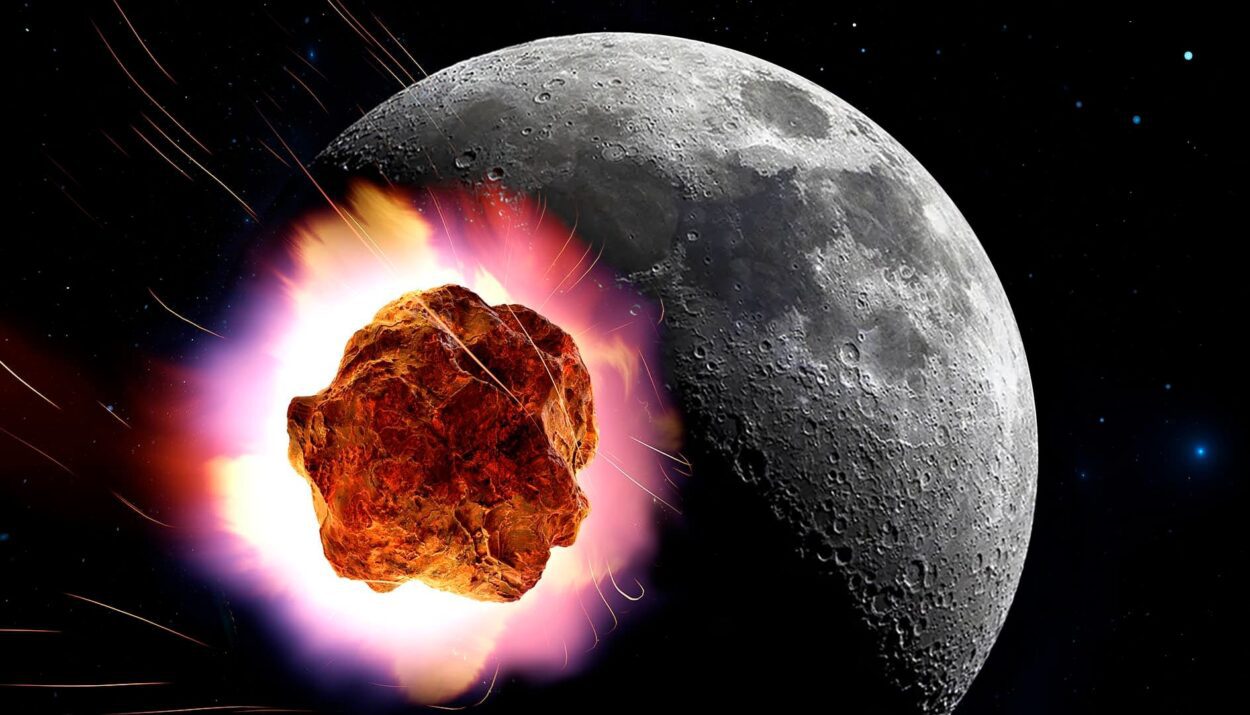
Scientists are closely tracking a building‑sized asteroid that has a small but significant chance of hitting the moon in late 2032. The object, known as 2024 YR4, currently carries an estimated 4% probability of a lunar impact — and a roughly 1% chance of striking the moon in a way that ejects debris into near‑Earth space, potentially threatening satellites and astronauts.
“This could pose a lot of risks to Earth‑orbiting assets,” NASA aerospace engineer Brent Barbee warned during a presentation at the American Geophysical Union’s annual meeting.
A Potentially Visible Lunar Impact
If YR4 does collide with the moon, scientists estimate the impact would release energy equivalent to 6 million metric tons of TNT — about 400 times the force of the Hiroshima bomb.
There’s also an 86% chance the asteroid would hit the side of the moon facing Earth. If so, the resulting flash could be visible from Earth under good viewing conditions. Based on current projections, observers in Hawaii would have the best vantage point on the expected date of December 22, 2032, with the western United States also well positioned.
How Big Is YR4?
The asteroid’s exact size and mass remain uncertain, though early observations — including images from the James Webb Space Telescope — suggest it is roughly 60 meters wide. That uncertainty complicates any attempt to deflect it.
Barbee noted that scientists do not yet know enough about the asteroid to safely nudge it off course. A more realistic option, he said, might be to intentionally break it apart using a high‑speed impactor or even a nuclear device. Such an intervention would need to occur at least three months before a potential lunar strike to ensure debris disperses safely away from Earth.
A Narrow Window for Action
Researchers hope JWST will observe YR4 again in February 2026, which could refine the asteroid’s orbit. Those observations might either rule out a lunar impact entirely or raise the probability to as high as 30%.
If JWST cannot observe the asteroid for any reason, Barbee cautioned, decision‑makers may face the prospect of planning a mitigation mission under considerable uncertainty.
Given the long lead times required for spacecraft development, any reconnaissance or deflection mission would need to begin very soon if the risk persists.