
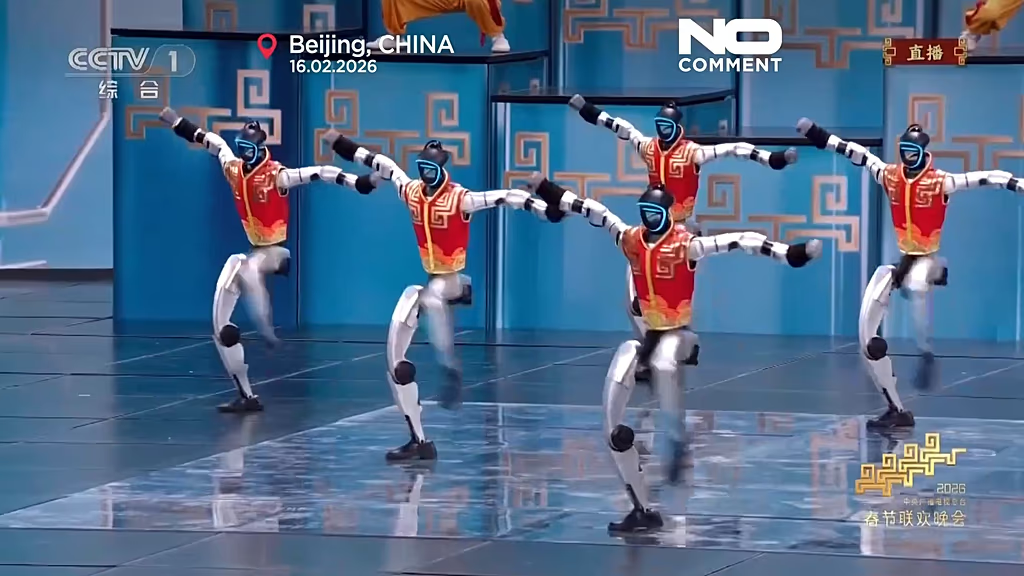
China’s Lunar New Year Gala drew global attention this year as humanoid robots took center stage, performing tightly choreographed martial arts and parkour routines that pushed the boundaries of what these machines have shown publicly before.
According to footage released by CCTV, two dozen robots executed a series of first‑ever feats: continuous freestyle table‑vaulting parkour, an aerial flip, repeated single‑leg flips, a two‑step wall‑assisted backflip, and a 7.5‑rotation Airflare grand spin. It was a striking display of China’s accelerating progress in robotics and AI‑driven motion control.
The leap in performance was especially noticeable compared to last year’s gala, where humanoid robots wobbled through a folk dance routine. This year’s machines appeared far more stable and coordinated — a sign of rapid iteration and growing technical maturity.
Beyond the spectacle: how advanced is the technology?
Despite the impressive choreography, experts caution that staged performances reveal only part of the picture. Around the world, companies are testing humanoid robots in warehouses, factories, and — eventually — homes. Some analysts also see potential military applications.
“There is likely room for robots in the shape of humans and animals in military and security organisations, especially if they need to interact with environments built for humans,” Hans Liwång, professor of systems science for defence and security at the Swedish Defence University, told Euronews.
But he stressed that real‑world deployment is far more demanding than a controlled stage show. In unpredictable environments, the robot’s physical form matters less than whether it has sufficiently advanced decision‑making and autonomy.
Liwång also warned against taking high‑profile demonstrations at face value.
“A rehearsed, preplanned, and controlled show does not tell us that much about the state of the technology. Such shows are designed to impress, and therefore likely overstate the capability,” he said.
Should Europe be worried?
Liwång argues that Europe doesn’t need to panic — but it does need to stay alert.
“Europe needs to be informed about international development. We need to learn from others, not build from scratch,” he said. “We need to learn from the efforts put into this development and from the technical development.”
The global humanoid robotics race is increasingly dominated by China and the United States. China’s edge comes from its manufacturing scale, government support, and a highly integrated robotics supply chain that allows companies to scale quickly and drive down costs.
Unitree Robotics — whose humanoids featured prominently in the gala — lists a base price of $13,500 (€11,280) for its G1 robot. Tesla has not yet announced a commercial price for its Optimus robot, though Elon Musk has suggested production costs could eventually fall below $20,000 (€16,700) if output reaches one million units per year.
According to a 2024 report from the International Federation of Robotics, China remains the world’s largest industrial robot market, accounting for more than half of all global robot installations that year.
A dazzling show — and a strategic signal
China’s New Year performance was more than entertainment. It was a message: the country intends to lead in robotics, and it is moving fast. The real question for Europe is not whether to be alarmed, but whether it can keep pace with the scale, speed, and ambition driving China’s technological push.