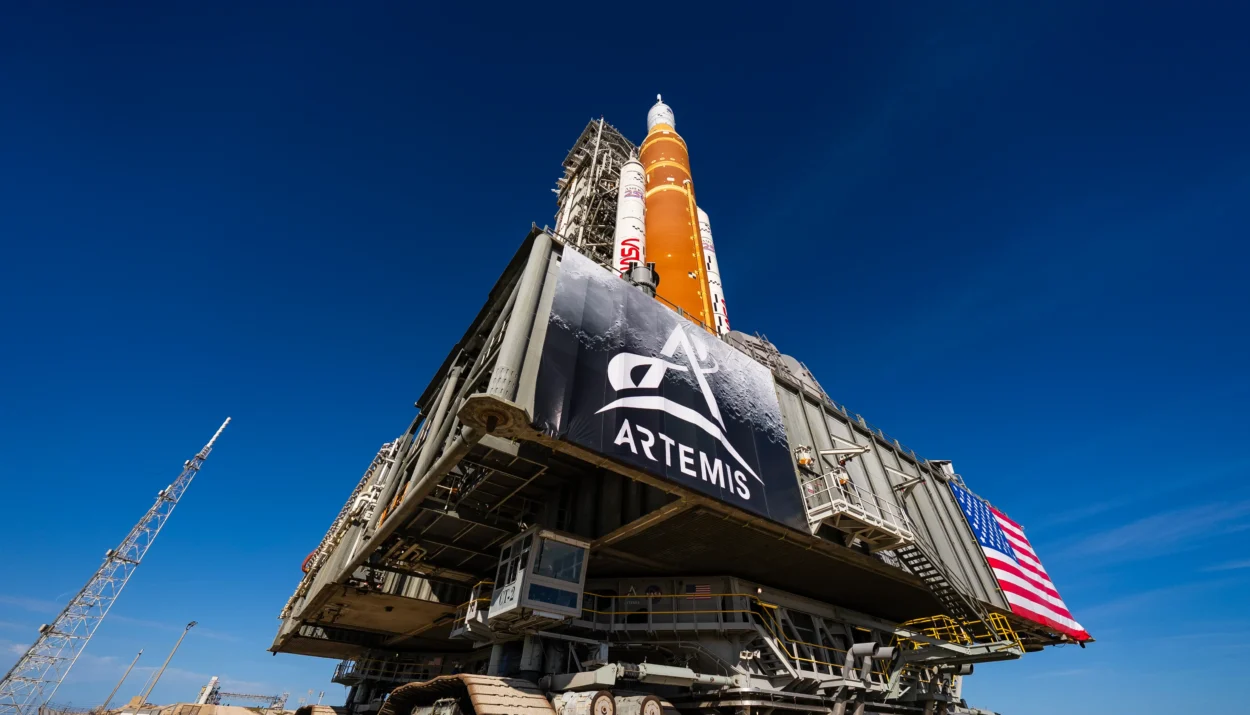
NASA’s hopes for a March launch of the Artemis II mission have dimmed just a day after the agency floated March 6 as a possible target. On Saturday, officials announced that a technical complication involving the rocket’s helium system may force the spacecraft to roll back from the launch pad — a move that would eliminate all March launch opportunities at Kennedy Space Center.
Artemis II is slated to send four astronauts on a 10‑day journey around the moon, marking humanity’s first return to lunar proximity since Apollo 17 in 1972. The crew includes Christina Koch and Jeremy Hansen, who recently trained inside the International Space Station mockup at NASA’s Johnson Space Center.
Helium Flow Problem Prompts Concern
In a blog update, NASA reported that technicians detected an “interrupted flow of helium” within the rocket’s systems. Helium plays a critical role in pressurizing various components during launch. The agency says engineering teams are reviewing data and working to understand the cause while determining the safest next steps.
If the rocket and Orion spacecraft must be moved back to the Vehicle Assembly Building for further inspection, NASA’s five March launch windows will no longer be viable. The agency currently has six potential opportunities in April.
NASA noted that a similar helium‑related issue surfaced during the uncrewed Artemis I mission in 2022, when teams had to troubleshoot upper‑stage pressurization before launch.
Optimism Followed by Setbacks
The announcement comes just one day after NASA leaders expressed confidence following the mission’s second “wet dress rehearsal,” a full countdown simulation involving fueling procedures. “This is really getting real,” said Lori Glaze, acting associate administrator for NASA’s exploration systems development mission directorate. “It’s time to get serious and start getting excited.”
But earlier tests this month revealed several complications, including a liquid hydrogen leak during fueling. Engineers replaced seals and performed additional work, and officials said the most recent rehearsal proceeded smoothly overall — despite a temporary loss of ground communications in the Launch Control Center that forced teams to switch to backup systems.
What Comes Next
NASA has not yet determined the root cause of the helium interruption, and engineers are continuing to analyze data. Whether the rocket remains on the pad or returns to the assembly building will dictate the mission’s timeline.
For now, the agency is balancing optimism with caution as it works to keep Artemis II — the first crewed step toward returning humans to the moon — on track.