
In a landmark 6–3 decision, the U.S. Supreme Court struck down President Donald Trump’s sweeping global tariffs, ruling that he exceeded his authority under the International Emergency Economic Powers Act (IEEPA). The decision represents one of the most consequential judicial checks on presidential trade power in recent history and has triggered immediate political, economic, and international repercussions.
Why the Court Struck Down the Tariffs
The central legal question was whether the president could use IEEPA—a 1977 law designed for national emergencies—to impose broad, peacetime tariffs on nearly all U.S. trading partners.
The Court ruled that he could not.
The majority opinion, written by Chief Justice John Roberts, held that IEEPA does not authorize the president to unilaterally impose tariffs of this scope.
The ruling upheld earlier decisions from lower courts that had already found the tariffs unlawful.
The Court emphasized that the U.S. Constitution gives Congress, not the president, the power to impose tariffs during peacetime.
This marks the first time the Supreme Court has directly evaluated the legality of one of Trump’s second‑term economic policies.
Trump’s Reaction: Anger, Defiance, and New Tariffs
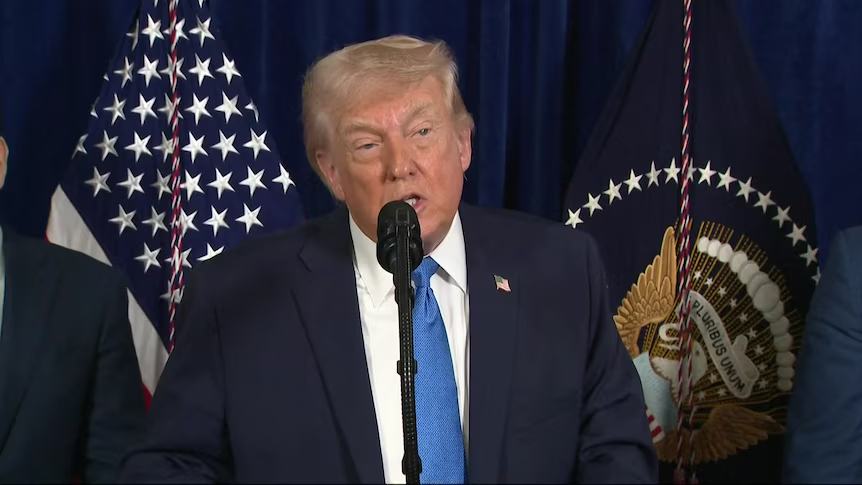
President Trump responded with visible frustration, calling the ruling a “disgrace” and accusing the justices—including two of his own appointees—of undermining national interests. He quickly announced a workaround: a new 10% global tariff imposed under a different trade statute, signaling that he has no intention of abandoning his tariff‑driven agenda. Despite the Court’s ruling, Trump insisted he had “very powerful alternatives” and suggested that the new tariffs could generate even more revenue than the ones struck down.
Economic Fallout: Limited Shock, but Big Questions Ahead
Economists expect the immediate macroeconomic impact to be modest, but the long‑term effects remain uncertain.
Key points emerging from early analysis:
Markets reacted cautiously but not dramatically.
Tariff‑sensitive sectors—especially retail and manufacturing—may benefit from the rollback.
A wave of refund claims is expected from businesses that paid billions under the invalidated tariffs.
The Penn Wharton Budget Model estimates up to $175 billion in potential refunds, though the process may be slow and legally complex.
Some analysts warn that companies may rush to import goods ahead of Trump’s next tariff moves, potentially distorting short‑term trade flows.
International Repercussions: India, Canada, and Beyond
India: A Trade Deal Thrown Into Uncertainty
India’s political opposition sharply criticized the government for finalizing a major trade framework with the U.S. just days before the ruling.
Critics argue that India made significant concessions—such as agreeing to zero tariffs on many U.S. goods—based on a tariff regime that has now been invalidated.
They warn that the two countries may revert to the pre‑2025 status quo, complicating ongoing negotiations.
Canada: Relief, but Not Celebration
Canadian markets reacted only mildly to the ruling.
Although Trump’s tariffs had hurt sectors like steel, lumber, and autos, much of Canada’s economy—especially banking, energy, and utilities—remained largely insulated.
Analysts caution that despite the ruling, Canadian investors should remain vigilant, as Trump has already announced new tariffs under different laws.
What Happens Next?
The Supreme Court’s decision does not eliminate the president’s ability to impose tariffs altogether—it simply restricts the use of IEEPA for that purpose. Trump has already pivoted to other legal authorities, and more tariff actions are expected.
Meanwhile:
Businesses are preparing for a complex refund process.
Economists are watching for inflationary or deflationary effects as tariffs shift.
Congress faces renewed pressure to clarify the limits of presidential trade authority.
U.S. trading partners are recalibrating their strategies in response to the ruling and Trump’s new tariff plans.
Conclusion
The Supreme Court’s ruling marks a pivotal moment in U.S. trade policy, reasserting congressional authority and curbing the president’s unilateral power to reshape global commerce. Yet the broader tariff battle is far from over. President Trump’s swift move to impose new duties ensures that the political and economic debate over tariffs will continue to shape U.S. policy—and global markets—for months to come.