
Zahi Hawass — Egypt’s most recognizable archaeologist and a global celebrity in his field — believes he may be on the brink of the discovery he has chased for decades: the long‑lost tomb of Queen Nefertiti.
The 76‑year‑old former antiquities minister makes the claim in The Man with the Hat, a new documentary chronicling his life, controversies, and relentless pursuit of ancient Egypt’s greatest mysteries. Directed by Jeffrey Roth, the film premieres on major streaming platforms on January 20.
A Career‑Defining Quest
Hawass says that finding Nefertiti’s burial would be the ultimate capstone to his career.
“If I made this discovery, I think I would be happy to end my career with the most important discovery of the most important queen of Egypt,” he says in the film.
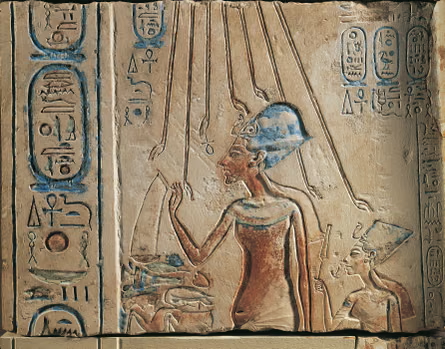
Nefertiti, famed for her beauty and political influence, ruled alongside Pharaoh Akhenaten during a turbulent period of religious upheaval in the 14th century B.C. Some scholars — Hawass among them — believe she later ruled as pharaoh under the name Neferneferuaten.
Digging in the Valley of the Kings
Hawass and his team have spent years excavating the Valley of the Kings, uncovering two previously unknown tombs, KV65 and KV66. Though both were looted in antiquity, they helped refine the map of the valley and narrow down the search for Nefertiti’s burial place.
The current excavation is focused on the eastern Valley of the Kings, near the tomb of Hatshepsut — another powerful female ruler. Hawass admits he has no hard evidence that Nefertiti lies there, but he trusts his instincts.
“There is one area now that we are working in the east valley, near the tomb of Queen Hatshepsut. I’m hoping that this could be the tomb of Queen Nefertiti,” he told Live Science. “This discovery could happen soon.”
A Push for Repatriation
The documentary also highlights Hawass’s long‑running campaign to bring several iconic Egyptian artifacts back home: the Rosetta Stone, the Dendera Zodiac, and the famous bust of Nefertiti.
He argues that these objects — now in museums in London, Paris, and Berlin — are central to Egyptian identity and belong in the newly opened Grand Egyptian Museum.
A Career Marked by Triumph and Turbulence
Hawass’s public life has not been without controversy. After Egypt’s 2011 revolution, he briefly faced a prison sentence over a dispute involving a museum gift shop — a ruling later overturned. He was also barred from traveling abroad for a period during investigations into other complaints, though he was never charged.
He addresses these episodes in the documentary, saying that fame made him a target but insisting he acted with integrity throughout his career.