
The global political landscape is shifting rapidly, with several regions experiencing heightened tensions, strategic realignments, and domestic unrest. Today’s major international stories span from the Middle East to Europe and Latin America, reflecting a world grappling with conflict, economic pressure, and geopolitical competition.
🇮🇷 Iran Faces Widespread Protests and Harsh Crackdowns
Iran is confronting one of its most serious internal crises in decades. Protests have spread across multiple cities, fueled by deep economic hardship and frustration with the government’s policies.
The country is experiencing internet blackouts as authorities attempt to contain the unrest.
Iran’s supreme leader has accused demonstrators of acting on behalf of foreign powers, including the United States.
Reports indicate a rising number of casualties as security forces intensify their response.
Analysts suggest this may be the most significant challenge to Iran’s leadership since the 1979 revolution, with the government’s legitimacy increasingly questioned.
🇺🇦 Russia Escalates Attacks on Ukraine With Rare Hypersonic Missile
Russia launched a new wave of strikes across Ukraine, including the use of a rare Oreshnik hypersonic missile, a weapon not deployed since 2024.
Kyiv’s mayor has urged residents without heating to evacuate as infrastructure damage mounts.
The attack comes amid broader concerns about Russia’s evolving military strategy and its willingness to deploy advanced weapons near NATO borders.
Western governments continue to monitor the situation closely, with renewed calls for increased support to Ukraine.
🇻🇪 Venezuela Crisis Deepens as U.S. Tightens Control Over Oil Shipments
The United States has intercepted multiple oil tankers linked to Venezuela in the past week, part of a broader effort to enforce sanctions and reshape global oil flows.
U.S. officials argue that Venezuelan oil is being used to bypass sanctions and destabilize markets.
Energy analysts warn that political uncertainty in Venezuela complicates efforts to revive its oil industry.
The situation has triggered diplomatic tensions, with Venezuela accusing Washington of economic aggression.
🇬🇱 Greenland Becomes an Unexpected Flashpoint in U.S. Politics
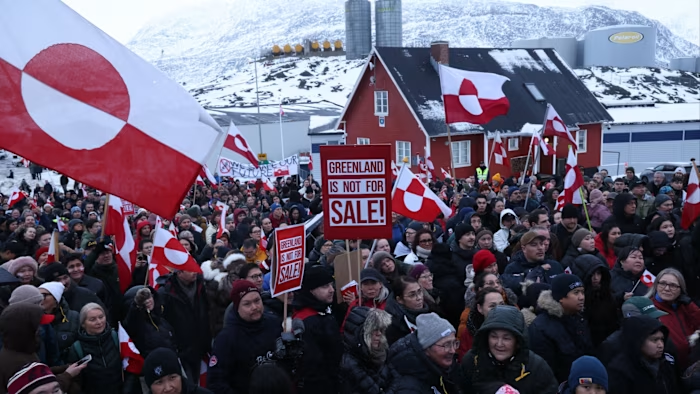
Greenland has re‑entered the geopolitical spotlight after statements from U.S. leadership suggesting renewed interest in the island’s strategic value.
Greenlandic labor leaders have publicly rejected any notion of U.S. control, emphasizing national sovereignty.
Analysts note that Greenland’s location and natural resources make it a key point of interest in Arctic geopolitics.
The debate underscores the growing strategic competition in the Arctic between the U.S., Russia, and China.
🇵🇭 Deadly Landfill Collapse in the Philippines Sparks National Outcry
A massive landfill collapse in Cebu has killed at least two people and left dozens missing.
Rescue operations are ongoing, with authorities warning that unstable terrain complicates efforts.
The tragedy has reignited debates over waste management and environmental policy in the Philippines.
While not strictly political, the disaster is expected to have significant policy repercussions.
🇨🇴 Colombia Reports Diplomatic Breakthrough After Call With the U.S.
Colombia’s president has described a lengthy call with U.S. leadership as a “breakthrough,” easing fears of potential military escalation in the region.
The conversation reportedly addressed security concerns and bilateral cooperation.
The development comes amid broader tensions in Latin America involving Venezuela and U.S. policy shifts.
🧭 A World in Flux
Today’s international political landscape is defined by volatility:
Domestic unrest in Iran,
Escalating conflict in Ukraine,
Energy geopolitics involving Venezuela,
Strategic competition in the Arctic, and
Diplomatic recalibration in Latin America.
These events highlight a world where regional crises increasingly intersect with global power dynamics.