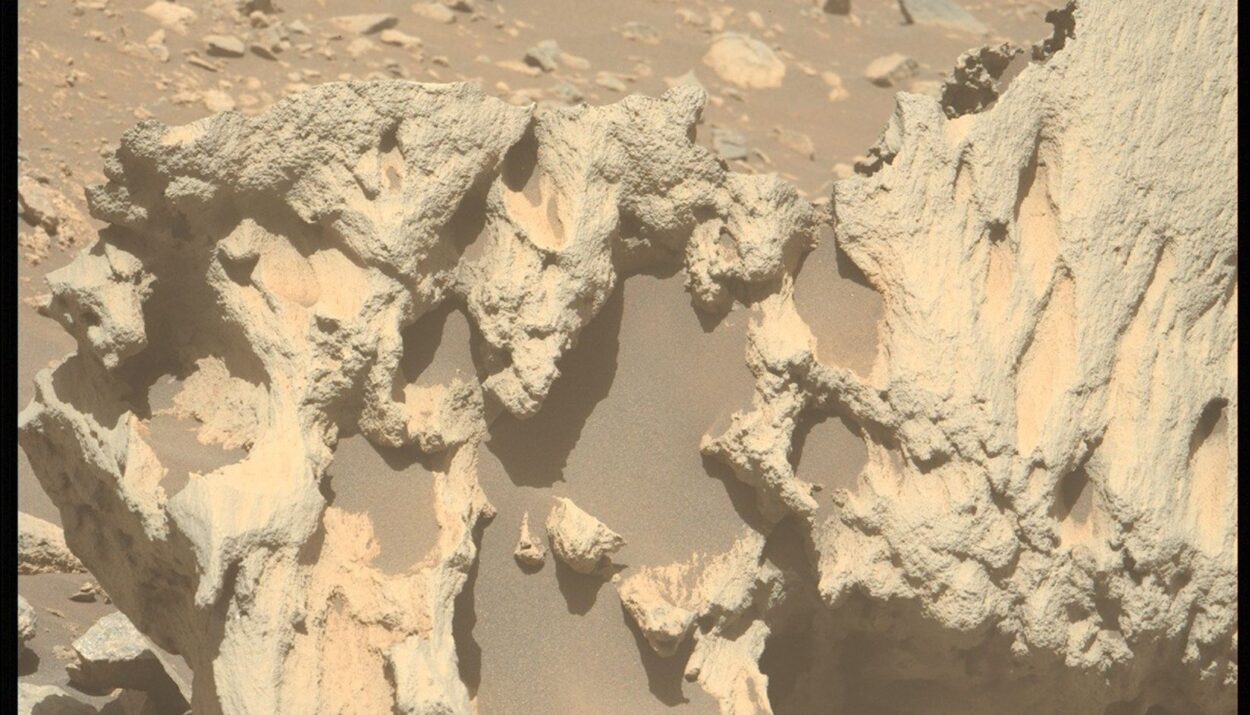
For more than five years, NASA’s Perseverance rover has been roaming the dusty surface of Mars, searching for clues about the planet’s ancient past. Recently, the rover stumbled upon something truly unexpected inside Jezero Crater: an 80‑centimeter rock named Phippsaksla, whose appearance stands out dramatically from everything around it.
Researchers were immediately intrigued. The rock’s shape and texture don’t match the surrounding Martian landscape. Early analyses even suggest something remarkable: Phippsaksla may not be native to Mars at all. It could be a visitor from elsewhere in the Solar System — or the product of geological processes never before observed on the Red Planet.
🔍 What Makes Phippsaksla So Unusual
Perseverance’s Mastcam‑Z cameras captured the rock from multiple angles, revealing a texture and morphology unlike the typical sedimentary formations in Jezero Crater.
But the real breakthrough came from the rover’s SuperCam instrument. Using lasers and high‑precision spectrometers, scientists determined the rock’s chemical “identity card.”
The results were striking:
Phippsaksla contains exceptionally high levels of iron and nickel — a signature characteristic of metallic meteorites.
Metallic meteorites form under extreme conditions inside large asteroids, where intense heat causes heavy elements to migrate toward the core. Compared to rocky meteorites, these iron‑nickel bodies are relatively rare.
Finding such an object on Mars points to a long history of meteor bombardment that shaped the planet’s surface over billions of years.
Although other metallic meteorites have been found on Mars during previous missions, it is surprising that Perseverance had not encountered one earlier in its journey.
🧪 Why This Discovery Matters
Located in the Vernodden region, Phippsaksla is scientifically valuable. Each meteorite found on Mars acts as a time capsule, preserving information about the composition of ancient celestial bodies from the early Solar System.
It also helps scientists understand the intensity and timing of meteor impacts that sculpted the Martian crust.
Further analyses will be needed to confirm the rock’s extraterrestrial origin. If NASA decides to collect a sample, it could join the rover’s growing cache of specimens awaiting a future — still hypothetical — mission to return them to Earth.
Perseverance itself cannot bring samples home; a separate retrieval mission will be required.
🚗 Perseverance Continues to Exceed Expectations
Since its spectacular landing in February 2021, Perseverance has far surpassed expectations. It has explored ancient lakebeds, documented fascinating geological formations, and detected signs suggesting that Mars may once have hosted conditions suitable for microbial life. It has even set new distance‑travel records for a rover on another world.
Phippsaksla is likely just one more milestone in a scientific adventure that still promises many discoveries.