
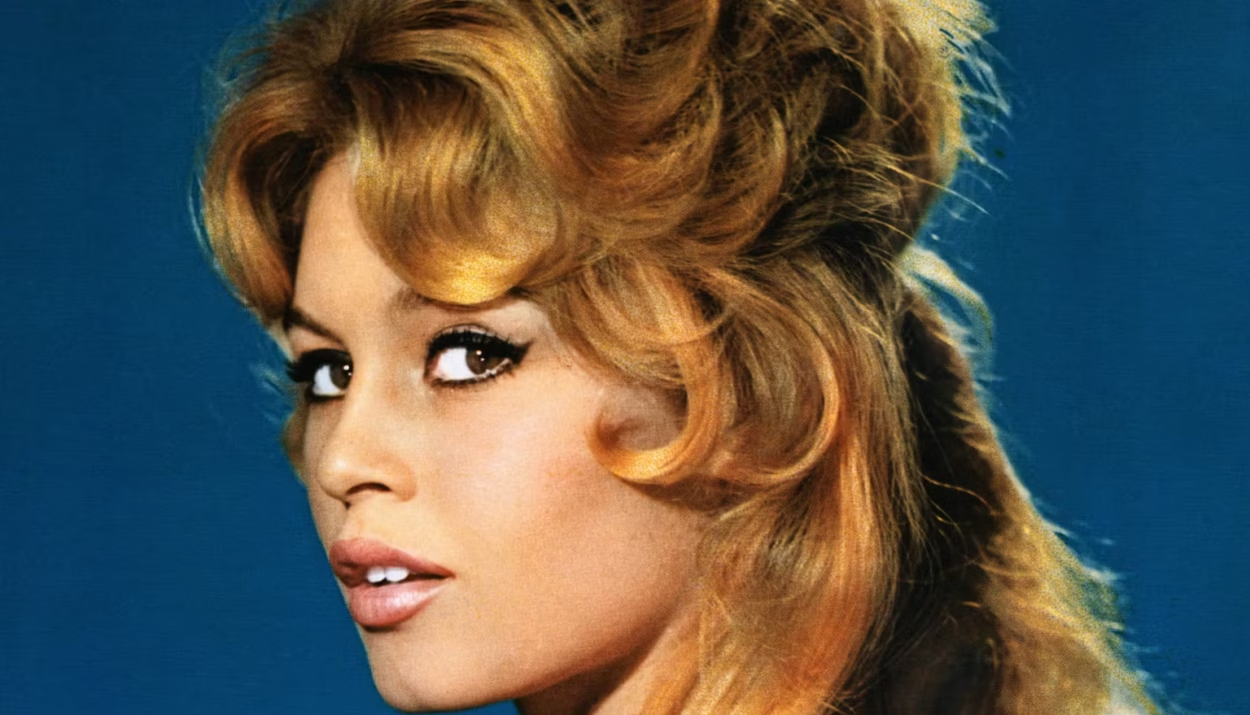
Brigitte Bardot, one of France’s most recognizable film stars and later a polarizing public figure, has died at the age of 91, her foundation announced on Sunday.
During the 1950s and 1960s, Bardot embodied a new kind of cinematic sensuality. With her striking looks, smoky eyes, and unmistakable pout, she became an international symbol of liberated femininity—often compared to Marilyn Monroe. Yet the woman known simply as “BB” grew weary of the relentless attention. In 1973, at the height of her fame, she abruptly left the film world behind to devote herself entirely to animal protection.
A Meteoric Rise to Stardom
Bardot appeared in more than 50 films, many of them light, playful productions that made her a household name even if they didn’t always win over critics. Her breakthrough came in 1956 with And God Created Woman, directed by her then‑husband Roger Vadim. The film’s provocative energy—and Bardot’s now‑legendary mambo scene—shocked censors and cemented her status as a global sensation.
She later delivered one of her most memorable performances in Jean‑Luc Godard’s Contempt (1963), where the director famously played with the audience’s expectations by fragmenting shots of her body into a stylized montage.
Writers and intellectuals of the era were fascinated by her. Marguerite Duras described Bardot as standing “where morality ends,” while Simone de Beauvoir called her a woman who “does as she pleases”—a quality that unsettled many in conservative postwar France.
A Retreat From Fame
Behind the glamour, Bardot struggled with the pressures of objectification. She attempted suicide at 26 and ultimately chose to walk away from cinema before turning 40, later saying she wanted to leave the industry “first,” before it left her.
Born in Paris in 1934 and raised in a traditional Catholic family, Bardot married four times and had one son, Nicolas, with actor Jacques Charrier.
A Life Devoted to Animals
After retiring from film, Bardot withdrew to Saint‑Tropez and transformed herself into one of the world’s most outspoken animal rights activists. A 1980s trip to Canada, where she witnessed the killing of seal pups, became a turning point. She later wrote that the screams of the animals “still torture me” and inspired her to dedicate her life to their protection.
In 1986 she created the Brigitte Bardot Foundation, which campaigned for causes ranging from ending seal hunts to banning horse slaughter and ritual animal sacrifice.
A Controversial Later Life
In her later decades, Bardot’s public statements increasingly aligned with the far right. She was convicted five times for inciting racial hatred due to comments targeting Muslims, immigrants, and LGBTQ people.
Her 2003 book A Cry in the Silence warned of what she called the “Islamisation of France,” and she openly supported Marine Le Pen in the 2012 and 2017 presidential elections. Le Pen once referred to her as the “Joan of Arc of the 21st century.”
Bardot also rejected the #MeToo movement, calling many actresses “hypocritical” and insisting she had found male attention flattering rather than oppressive.
A Legacy Both Celebrated and Contested
Brigitte Bardot leaves behind a complex legacy: a dazzling screen presence who helped redefine female sexuality on film, a pioneering animal rights activist, and a figure whose later political views sharply divided public opinion.
Her death marks the end of an era in French cinema—one shaped as much by her mythic allure as by her decision to abandon fame in pursuit of a cause she believed in with uncompromising passion.